
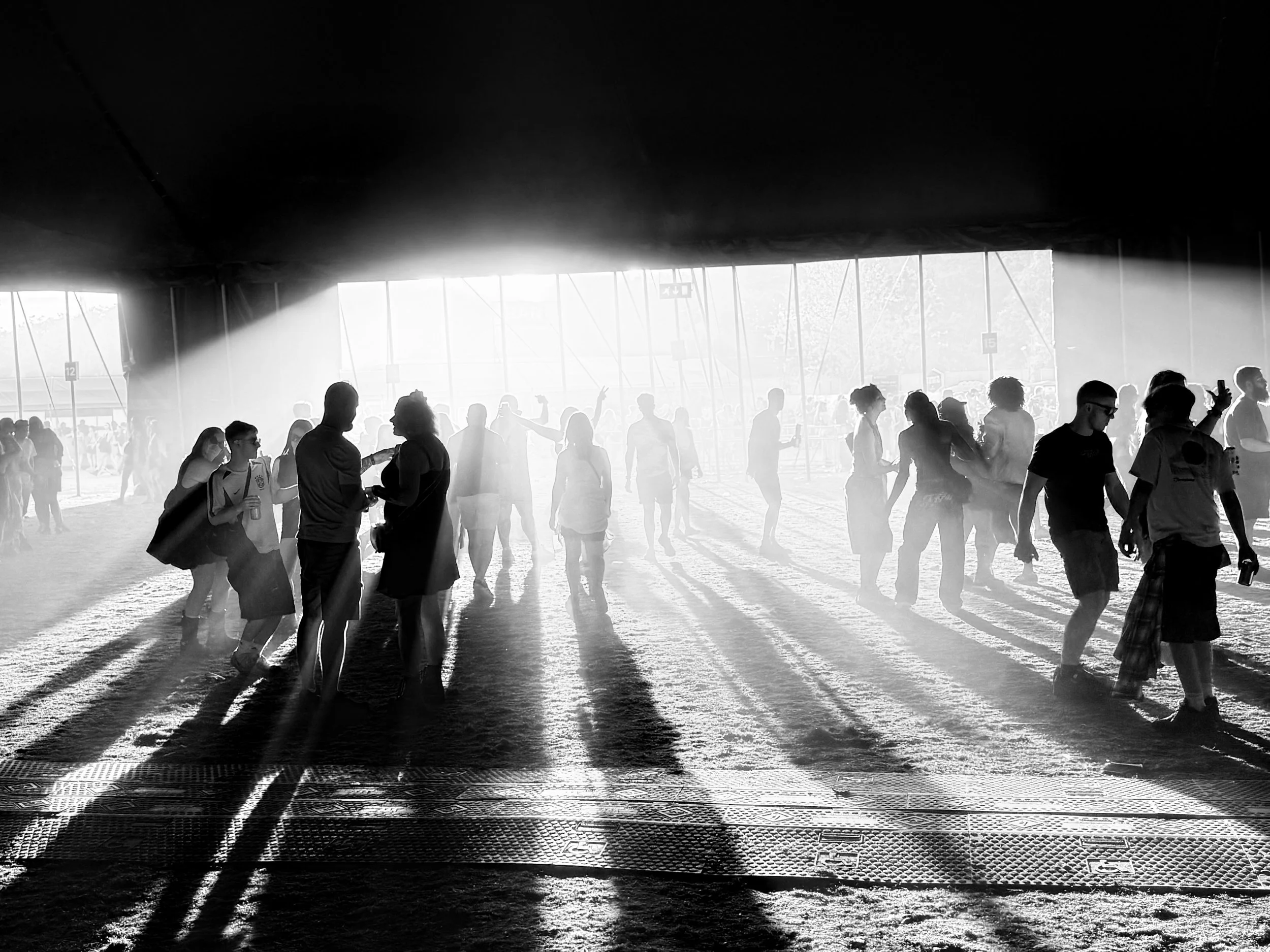
Entrance to the Big Top @ All Points East Summer 2025
Written by Dhyana Rao-Middleton
Remember the first mixtape someone made for you? It wasn't the most popular songs of the week, it was a person telling you something: this reminded me of you, you need to hear this, I’m obsessed with this, here's what I'm vibing to right now. Social media was meant to work a bit like that. A place where the people you care about could share what they’re doing or what grabbed their attention recently, and you could share back.
Somewhere along the way, the feed stopped being a conversation between friends and became a broadcast chosen by a machine, and that machine was never built to bring us closer together. It was built to keep us there, watching, so that every minute of our attention could be packaged and sold. In the process, the very voices that make music worth sharing are being quietly turned down.
Your friends have left the feed
The people we actually care about have all but disappeared from our screens. In April 2026, the UK think tank IPPR analysed feeds across Instagram, Facebook, X, Bluesky and TikTok and found that just 18% of the top posts people saw came from someone they actually know, while 35% came from influencers, public figures or recommended content and another 29% from adverts and brands. On TikTok and X, friends and family accounted for only one post in ten. Think about what that means: open any of these apps, and four out of every five things in front of you were chosen by a system that has never met the people you love.
Meta's own numbers show this was no accident. During its 2025 antitrust trial in the US, the company revealed that time spent viewing friends' posts had fallen from 22% to 17% on Facebook and from 11% to 7% on Instagram in just two years. By the end of 2024, a third of US Facebook feed views (33.6%) came from accounts people had never chosen to follow, more than came from their own friends (27.8%). The word "social" is still on the label, but the people have been replaced by programming.
Built for profit, not for people
So why would a platform that grew up on friendship push our friends out of the frame? Because connection doesn't pay as well as attention. Celebrities and influencers arrive with enormous audiences, keep people watching for longer and bring the advertisers with them, which is exactly the kind of content an algorithm learns to reward. Your best friend's gig photos simply can't compete on those terms, however much they matter to you.
Meta made this painfully clear in its own legal brief. In a 2023 experiment, the company showed people 20% more posts from their friends, and when those people spent less time on the app, the friends lost. That single result tells you whose interests the feed really serves. Every extra minute we scroll means another advert served and more personal data gathered to sharpen the next one, so the system is designed to keep us there whether or not that time leaves us feeling any more connected.
What we lose in the trade is our own intention. We know what we're looking for: the sound of a scene we love, a recommendation from someone whose taste we trust, the artist a friend couldn't stop talking about. Algorithms take that search away from us and replace it with whatever they already know will hold our gaze, and before long we're scrolling on autopilot instead of listening, sharing and choosing with purpose. Social media should feel like walking into a room full of people you know, not like being strapped to a conveyor belt.
Spotify plays the same tune
Music streaming runs on the very same logic, and Spotify shows just how far it can go when profit sets the tempo.
Take Discovery Mode, which lets artists and labels buy their way into Spotify's recommendations by accepting a lower royalty, with Spotify taking a 30% commission on those streams in Radio and Autoplay. The Future of Music Coalition called it payola, and members of the US Congress warned it could set off a "race to the bottom" in which artists feel forced to give up income just to be heard. When visibility comes with a price tag, the artists who can afford to pay will always drown out the ones who can't.
Then there's the money itself. Since April 2024, any track with fewer than 1,000 streams in a year earns nothing at all, and its share is passed up to the tracks that clear the bar. That sounds like a small hurdle until you see the scale of it: Luminate found that of the 253 million tracks streamed in 2025, 120 million had 10 streams or fewer. The artists below that line are overwhelmingly new, local and independent, and the system now takes their small earnings and hands them to those who already have the most.
Even the playlists themselves have been bent toward the bottom line. Journalist Liz Pelly reported that Spotify filled its mood playlists for sleep, focus, chill and jazz with tracks from a handful of production companies released under made up names, music that costs Spotify less than the work of real artists. Every one of those placements is a spot a genuine musician in that genre could have earned, quietly handed to cheaper content instead.
Put it all together and the picture is hard to miss: pay to play, the popular get paid, and cheap content fills the gaps. The little guys were never part of the plan.
Who gets drowned out
When an algorithm learns from the past, it inherits all of the past's inequalities and then amplifies them, and the people who pay the price are the ones who have always fought hardest to be heard.
Women. Researchers at Utrecht University studied the listening of around 330,000 users over nine years and found that only 25% of the artists ever played were women. When they tested a widely used recommendation algorithm, the first recommended track was on average by a man, and so were the next six, leaving listeners waiting until track seven or eight to hear a woman at all. Every time someone plays what they're served, the algorithm takes it as proof that it got things right, making the loop tighter, and with less space for women.
LGBTQ+ artists. In 2020, the Australian Strategic Policy Institute found TikTok restricting the hashtags "gay", "lesbian" and "transgender" in several languages, which TikTok later put down to incorrect moderation. A University of Edinburgh survey of 627 UK TikTok users has since found that marginalised users, including LGBTQ+ people, often feel their content is suppressed even when it breaks no rules. For queer artists, whose music so often grows out of finding each other, being made harder to find isn't a technical glitch. It's a door being closed.
New and local artists. Without a major label budget behind them, these artists can't easily pay for boosts or playlist pitches, and an algorithm that learns from what's already popular keeps feeding popularity back to itself. The producer in the next postcode, the band playing your local venue on a Tuesday night, the singer who could be your new favourite: they never make the list, not because the music isn't good enough, but because the system was never listening for them.
Everyone deserves a voice
That's why we built Harmonize differently. The best music discovery has always come from people: the friend with impeccable taste, the DJ who reads the room, the cousin who sends you a track at 2am because it made them think of you. So we put people back at the centre, where they belong. You share playlists as digital mixtapes, see what your friends are actually listening to across streaming services, and talk about it together, the way music has always been meant to travel.
Every artist and every listener gets an equal playing feed. Nobody is pushed up because they're famous, and nobody is buried because they're a woman, queer, new or local. Finding what you love might take a little longer, but you'll be the one doing the finding, because truly only you know exactly what you’re looking for. What you discover will come from people rather than a profit margin, and your data will never be the product.
No feed engineered to keep you hooked. No hidden ranking deciding whose voice gets heard. Just music, and the people who love it. Because music was always meant to be shared by people.
Sources
IPPR, 'Anti-social media' shows twice as much content from strangers as posts from friends and family (April 2026)
Meta Transparency Center, Widely Viewed Content Report (Q4 2024)
MusicTech, Artists criticise Spotify's Discovery Mode royalties
Billboard, Congress concerned about Spotify's Discovery Mode
DJ Mag, Spotify officially demonetises all tracks under 1,000 streams (April 2024)
Mixmag Asia, Luminate 2025 Year-End Music Report (January 2026)
Harper's, Liz Pelly, The Ghosts in the Machine (January 2025)
The Conversation, Ferraro and Bauer, Music recommendation algorithms exclude female artists (2021)
i-D, TikTok confirms it's been shadowbanning LGBTQ+ terms and hashtags (2020)
Ungless, Markl and Ross, Experiences of Censorship on TikTok Across Marginalised Identities (University of Edinburgh)
