
Not Every AI Music Tool Is the Problem. Consent Is the Line.
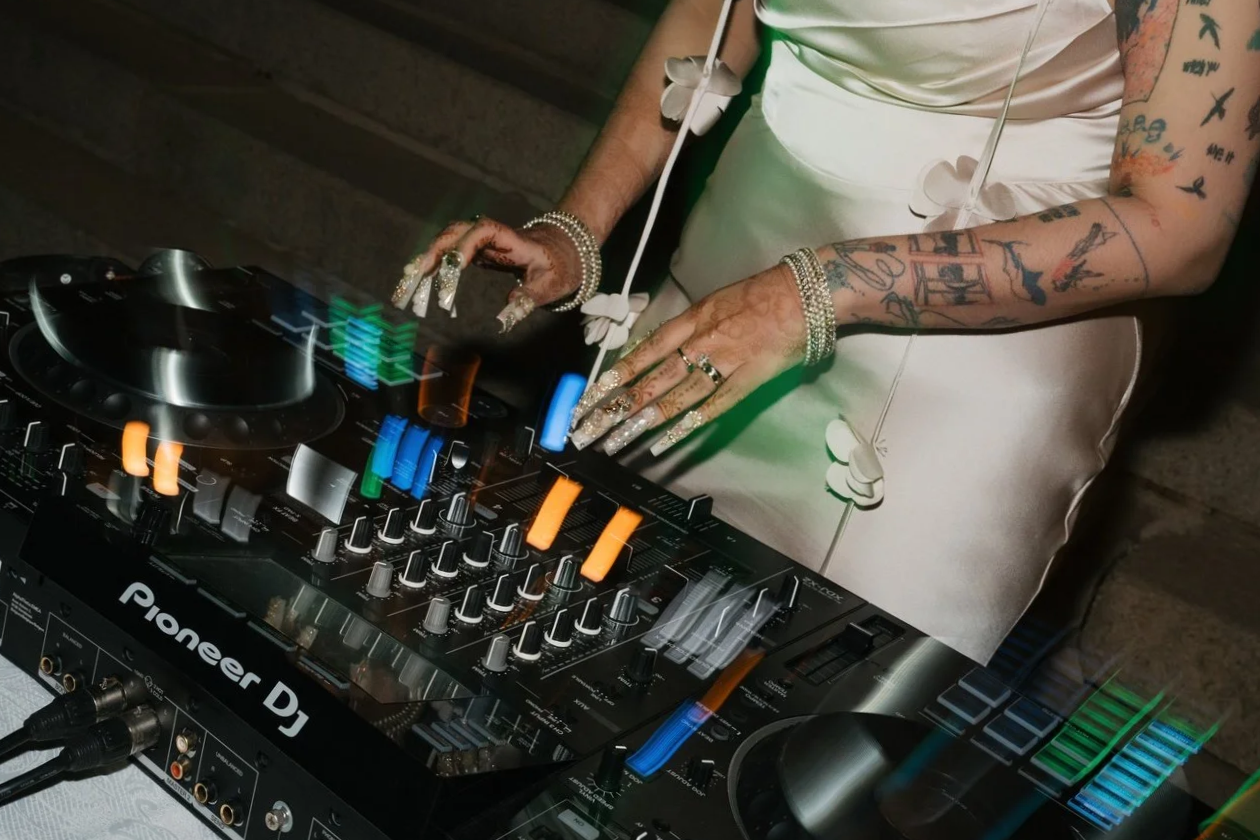
My hands on the decks at my own wedding.
Written by Dhyana Rao-Middleton
I want to say this plainly before anything else: I use AI to better my workflow and product design enhancement, but I can't bring myself to use it in my own music production. Why? Because I'm skeptical of most AI music tools, even the ones that get filed under the friendlier word "assisted." Not because I think the technology is incapable of being useful, but because the question that actually matters to me is whose creative work trained it, and whether that person ever agreed to it.
That's a narrower line than "AI good" or "AI bad," and I think it's the right one. If a tool helps me find a stronger chord progression, catches a note that's clashing, or gives technical feedback on a mix, that's not reaching into someone else's creative heart without their permission; it's closer to a tuning fork than a ghostwriter. But the moment a system generates music by drawing on patterns learned from other people's actual creative work, without their consent, it stops being a tool. It becomes something else. In the last few months, I've watched the word "assisted" get used to describe both of those things, as if they were the same.
Where it's working like a tool
Warner Music Group's settlement with Suno is a genuine example of the tool version done reasonably well. As part of the deal, WMG says artists get "full control over whether and how their names, images, likenesses, voices, and compositions are used" in new AI-generated music going forward. Suno's launching licensed models this year. That's opt-in, forward-looking, and it's the shape of thing I actually want to see more of.
Notice the word "forward," though. That protection is about what happens next, it doesn't undo how Suno's existing models already learned what they learned. As part of the same deal, Suno acquired Songkick, WMG's concert-discovery platform. I'm not saying that's wrong. I am saying it's worth noticing that the settlement produced a real corporate transaction between two companies, while the protection for individual artists is a policy commitment, not a cheque.
Where it's working like leverage
This is the part that actually worries me. Several major labels have already written AI training rights directly into standard artist contracts, not as a separate, negotiated, compensated deal, but bundled into the paperwork everyone signs anyway. According to reporting on these contracts, Sony's B1 Recordings imprint claims "unlimited, exclusive rights" to use recordings "in models and systems of generative artificial intelligence." Believe's contracts permit licensing an artist's work to "research, train, develop and test" generative AI models. BMG has a specific "AI Right" baked into songs created during a contract term. Separately, the same reporting notes a broader industry pattern: some labels are stretching old licensing language, originally written for things like social media use, to now cover AI training, without putting new terms in front of the artist at all. It's not clear which specific labels do this; it's a pattern across the industry, not a claim about any one company named above.
Some artists who push back can win individual approval rights. But that protection has a hole in it: it doesn't extend to blanket catalog licenses, where a label can still hand an AI company access to an entire roster regardless of what any one artist negotiated for themselves. Attorneys working in this space have said, plainly, that artists on smaller distributors have even less room to push back than that.
This is exactly why 29 music organizations - artists, songwriters, and managers - published a joint letter in June calling for "no consent, no deal": explicit permission before any AI use, real transparency about scope and duration, no perpetual rights smuggled in through broad language or default opt-ins, and fair, clearly broken-down compensation. That letter exists because the tool version and the leverage version had started to look identical on paper, and somebody needed to draw the line back out loud.
The line just moved again
Two days after I published my first piece about AI, “Deslopification: Why AI Music Needs It’s Own Room”, Sony, Universal, and Warner — alongside a cluster of independents including Believe, BMG, Concord, Dirty Hit, Glassnote, HYBE, Mom+Pop, and Partisan, with IFPI's backing, agreed on a global standard for which AI-made tracks are even eligible to appear on official charts. Two of the three requirements are exactly what you'd hope: the music has to be "substantially human-made," and there has to be real anti-fraud compliance. But the first requirement is the one worth sitting with: the AI tooling used has to be "authorized" and "licensed."
Read that again, next to the Warner-Suno deal. Suno now has a license from Warner, which raises a real question worth asking out loud even though no one's confirmed the answer yet: does that mean music made with Suno's newly licensed models has an easier path to clearing the "authorized" bar than music made with a smaller, independent AI tool that hasn't cut a deal with a major label, regardless of how human-led the actual songwriting is? Nobody's said so explicitly. But if the answer turns out to be yes, the distinction that started as "how much did a human actually make this" will have quietly become "did the AI company involved pay the right people first." Those aren't the same question, and I don't think the second one is the one anybody set out to answer when this conversation started.
Where I land
I'm not going to pretend I have a clean fix for this. What I do have is a line I'm not willing to move: if a system is going to train on someone's creative work, their voice, their lyrics, the thing they made and put their name on, that has to be something the person actually agreed to. Not a clause repurposed from an old social media contract. Not a blanket license they never saw the terms of. Not a default they'd have to notice and opt back out of. Agreed to, in plain language, on purpose.
I'm not against every use of AI anywhere near music. A tool that catches a clashing note or flags a stronger chord isn't touching anyone's creative heart without permission, and I don't need to pretend otherwise to make this argument. But that's a much smaller category than the industry wants "AI-assisted" to mean right now. The test was never whether AI was involved. It's whether the person whose work trained it, whose voice it's imitating, or whose song it's built on top of, actually agreed to that. Ask who agreed to what, and you'll know whether you're looking at a tool or leverage.
Sources for the contract and deal details referenced above: Music Business Worldwide on the Warner–Suno settlement, reporting on label AI-training contract clauses, Digital Music News on the 29-organization transparency letter, and CelebrityAccess on the new chart-eligibility standard.
